Memorial Plaque Wording: Ideas, Examples & a Phrase Picker

Choosing the words for a memorial plaque is often the hardest part of ordering one. You want to sum up a whole life in a few lines, and you want it to be right. This guide takes you through it step by step, with real examples, a phrase picker you can tap to build your own wording, and tips on fitting it all on the plaque.
The short version: five steps
- Start with their name, the way people knew them.
- Add the dates: full dates, or just the years.
- Choose an opening line, such as "In loving memory of".
- Add one or two lines about who they were, or the family they leave behind.
- Finish with a short verse or closing phrase, if you'd like one.
1. The building blocks of a memorial plaque
Most plaques are built from the same few parts, in this order. You don't need all of them. Many of the most moving plaques use only three or four.
| Part | What it is | Example |
|---|---|---|
| Opening line | Sets the tone at the top | In loving memory of |
| Name | The biggest line on the plaque | Robert "Bob" Smith |
| Dates | Birth and passing, or just the years | 3 March 1946 – 2 August 2025 |
| Relationships | Who they were to the family | Loving husband of Joan, father of Kate and Tom |
| Tribute | A line about who they were | A gentle soul with a generous heart |
| Verse or closing | A final thought or blessing | Forever in our hearts |
2. Getting the name right
- Use the name people knew them by. If everyone called him Bob, say so: Robert "Bob" Smith.
- Maiden names are traditionally shown with née: Mary Jones (née Brown).
- Titles, ranks and honours can go before or after the name: Dr, Sgt, OAM.
- For two people on one plaque, give each person their own name and dates, joined with "and" or "&".
- Check the spelling with family before you approve the proof, especially unusual spellings and middle names.
3. Choosing a date style
There's no right or wrong style. Choose one that suits the plaque and use it the same way all the way through.
| Style | Looks like | Good for |
|---|---|---|
| Full dates | 12 April 1938 – 9 November 2024 | Graves, headstones and family history |
| Numbers | 12.04.1938 – 09.11.2024 | Smaller plaques and modern designs |
| Years only | 1938 – 2024 | Benches, trees and short tributes |
| With age | Aged 86 years | Adding beneath the dates |
| Single date | Planted 9 November 2025 | Trees, gardens and dedications |
4. Phrase picker: tap to build your wording
Choose a theme, then tap any phrase to add it to your wording. You can edit it in the box, copy it, or send it straight to us with your quote request.
Opening lines
Mum & Nan
Dad & Pop
Grandparents
Husband, wife & partner
Son, daughter & child
Friend & sibling
Short & classic
Short verses
Faith
Fishing, gardens & the outdoors
Trees, benches & gardens
Service & community
Pets
5. Wording ideas by relationship
A few complete examples to get you started. Swap in the names and roles that fit your family.
6. Wording for different places
Graves and headstones
Traditional and complete: name, dates, relationships and a short line. Relationships such as "Loved wife of..., mother of..." help future generations trace the family.
Niche walls and columbariums
These plaques are small and spaced closely, so keep it brief: name, dates and one short line. Check the size your cemetery allows before you order.
Garden and rock plaques
A garden plaque can be personal and warm, as it's mostly read by family. A favourite saying or something they loved to do works beautifully. See garden plaques.
Trees
Passers-by may read a tree plaque, so a little context helps: "This tree was planted in memory of..." with a date. See tree plaques.
Benches and seats
Long and narrow, so one or two lines read best: "In memory of Jack & Elsie Turner, who loved to sit here and watch the river roll by."
Urns and keepsake boxes
Small plaques suit just the name and years, or a single short phrase such as "Forever loved".
Clubs, schools and workplaces
Mention the connection: years of service, a role or what they gave. "In memory of our coach and friend, who gave 30 years to this club."
Service and military
"Lest we forget" and service details such as unit, rank or years of service are common. Emblems can be engraved too; just send us a clear image.
Pets
Pet plaques can be playful and warm: their name, the years and a line like "Best mate, always". A photo makes it special. Our pet plaque wording guide has dozens more ideas, or see pet memorial plaques.
7. Faith and blessings
Many families include a short prayer, blessing or Bible verse. Keep it to one or two lines so it stays easy to read. A few traditional choices:
- "The Lord is my shepherd; I shall not want." (Psalm 23)
- "I am the resurrection, and the life." (John 11:25)
- "Blessed are they that mourn: for they shall be comforted." (Matthew 5:4)
- "Eternal rest grant unto them, O Lord, and let perpetual light shine upon them."
- "In God's care" or "Safe in the arms of Jesus"
Crosses, rosaries, doves and other religious symbols can be engraved beside the wording.
8. How much wording fits?
Fewer words in a larger font are easier to read, especially outdoors. As a rough guide for a name, dates and lines of tribute:
| Plaque size | Comfortably fits | Typical use |
|---|---|---|
| 90 × 60 mm | Name, years and 1 short line | Urns, keepsake boxes, small pet plaques |
| 150 × 100 mm | Name, dates and 2 to 3 short lines | Niche walls, garden stakes, trees |
| 200 × 150 mm | Name, dates and 3 to 4 lines | Garden rocks, posts and walls |
| 300 × 200 mm | Name, dates, 4 to 6 lines and an emblem or photo | Headstones, memorial walls |
| Long bench plaque | 1 to 2 lines | Bench seats and rails |
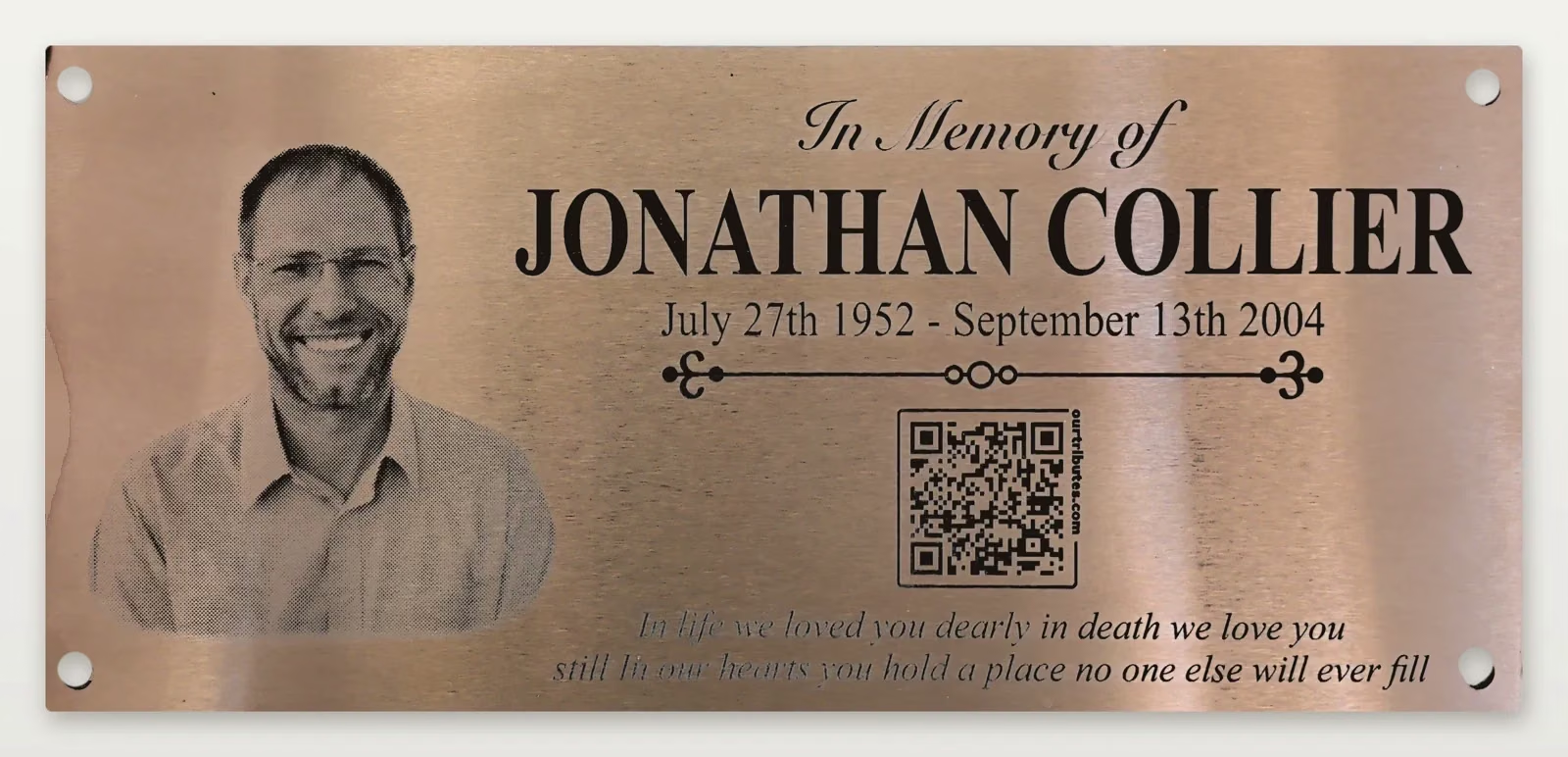
Have more to say than will fit? A story plaque adds a QR code that links to photos, stories and a full tribute online.
9. Layout and font tips
- Make the name the biggest line, then the dates, then the message.
- Use one or two fonts, not more. A script font for the opening line with clear capitals for the name is a classic pairing.
- Keep script fonts for short lines. Long sentences in script are hard to read.
- Leave some space around the edges. A crowded plaque is harder to read than a simple one.
- Centre-aligned wording suits most memorial plaques. Left-aligned suits longer stories.
10. Before you approve your proof
- Check every name, nickname and spelling.
- Check every date, and that the date style matches throughout.
- Read it out loud. If a line is hard to say, it may be hard to read.
- Ask someone else in the family to check it too.
- Check the plaque size suits where it's going, including any cemetery rules.
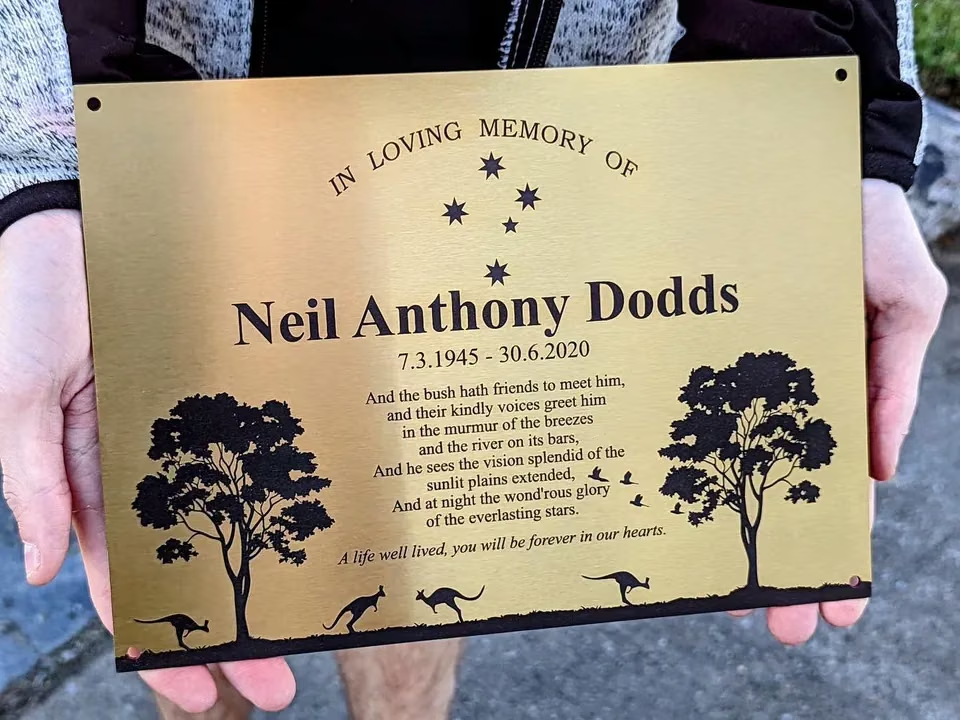
Examples from plaques we've made


Involve the family
Ask family and close friends what they'd like to say. It often brings out a phrase everyone agrees on, and it makes the plaque something the whole family owns. Our proof makes it easy to share the layout with everyone before you approve it.
Questions we often get
How many words fit on a memorial plaque?
It depends on the size. As a guide, a 200 x 150mm plaque comfortably fits a name, dates and three or four short lines. Send us your wording and we'll suggest a size that suits it.
Can you help with the wording?
Yes. Send us what you have, even if it's rough notes, and we'll lay it out and suggest tweaks on your free proof.
Can I add a photo or symbol?
Yes. Photos, religious symbols, emblems, flowers, birds and paw prints can all be engraved alongside the wording.
Should I use full dates or just the years?
Either is fine. Full dates suit graves and family history; years suit benches, trees and short tributes. Use one style throughout.
Can I see the plaque before it's made?
Yes. We send a free proof showing the exact layout, and nothing is engraved until you approve it.
Can you match an existing plaque?
Yes. Send a clear photo of the existing plaque and we'll match the layout and fonts as closely as we can.
Ready to talk about your plaque? Send us the details below, call 02 4030 5878 or email office@planetengraving.net.