Corten House Numbers: Rust, Run-Off and Where Not to Mount Them
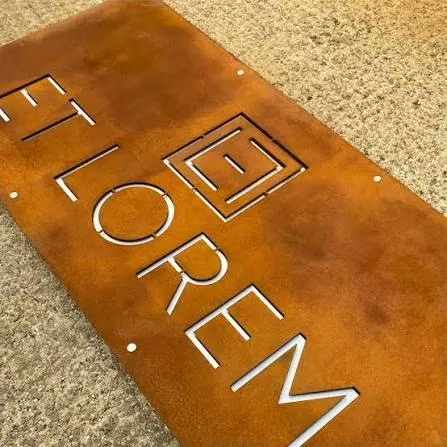
The short answer: corten is a weathering steel that rusts to a deep brown layer which protects the steel underneath. It looks great on timber, dark brick and in gardens. While that layer forms, rain washes rust coloured run-off down the wall, which can stain pale render, concrete and pavers. Mount it on standoffs, keep the bottom edge clear, or pick a different material for a pale wall.
How corten weathers
New corten arrives a dull grey. After the first few wet days it turns bright orange, then deepens to brown over the following months. Suppliers' estimates for the patina to settle range from about six months to well over a year, depending on rain, sun and how often the steel dries out between showers. Steel that stays damp, or is sheltered from rain completely, takes longer.
- Day 1Mill grey steel with a dark scale.
- First weeksBright orange rust appears after the first wet days.
- First monthsDeeper orange-brown. Run-off is at its heaviest.
- 6 to 18 monthsA dark brown patina settles in. It can take longer in dry weather.
- SettledDeep brown, and run-off slows right down.
Colours are an illustration, not a photo. Real timing depends on rain, sun and how often the steel dries out.
The run-off problem
Water running off new corten carries rust with it. On a dark brick wall or a timber fence you'll barely notice. On cream render, polished concrete, sandstone or light pavers it can leave orange streaks and drip marks that are hard to remove. The run-off eases as the patina settles, but it's worth planning for from day one.
How to mount corten numbers
- Use standoffs. A gap behind the numbers lets them dry out and stops water tracking straight down the wall.
- Keep the bottom edge clear of the wall, paving and garden edging.
- Put gravel or a garden bed underneath to catch drips, rather than a path.
- Pre-weather it. Leave the sign on gravel or grass for a few months before fixing it up, so the heaviest run-off happens somewhere it doesn't matter.
- Stay away from the surf. Constant salt spray stops the protective layer from settling. On the beachfront, choose 316 stainless instead.
Corten, powder coat or 316?
Answer three quick questions and we'll suggest a material, with mounting tips for your wall.
| Corten | Powder coated mild steel | 316 stainless steel | |
|---|---|---|---|
| Look | Rusty brown that deepens over time | Any solid colour, often matt black | Clean silver |
| Run-off | Yes, while the patina forms | No | No |
| Near the surf | Not recommended | Coating must stay intact | Best choice |
| Upkeep | None once settled | Touch up chips | An occasional wipe |
We laser cut house numbers and fence signs in all three materials, drawn up from your brief with a proof before we cut. For bigger custom shapes, see fibre laser metal cutting.
Questions we often get
Does corten stain concrete?
It can. Run-off from new corten can mark pale concrete, render and pavers while the patina forms. Standoffs, a gravel strip and pre-weathering all help.
Can I seal corten to stop the run-off?
Sealers are sold for this, but they change the look and usually need reapplying. Most people choose mounting and placement instead.
How long until it stops dripping rust?
It eases as the patina settles. Suppliers' estimates range from about six months to over a year, depending on the weather.
Ready to talk about your job? Send us the details below, call 02 4030 5878 or email office@planetengraving.net.